

What is the skin barrier?
When we talk about the skin barrier, we mainly mean the outermost layer of the epidermis: the stratum corneum.
This layer consists of skin cells surrounded by an organised structure of lipids, including ceramides, cholesterol and free fatty acids.
You can compare it to a brick wall. The skin cells are the bricks and the lipids fill the space between them. Together they allow the outer layer of the skin to do its protective job.
A well-functioning skin barrier helps limit excessive water loss from the skin and protects against external influences.
The acid mantle and the skin microbiome also play a role in the skin's balance. They are closely linked to the skin barrier, but they are not the same thing.
For daily skincare, the most important thing to know is that the skin barrier is constantly changing. The skin renews itself and responds to its environment, to the products you use and to the way you treat it.
Is your skin barrier damaged or disrupted? How to recognise it
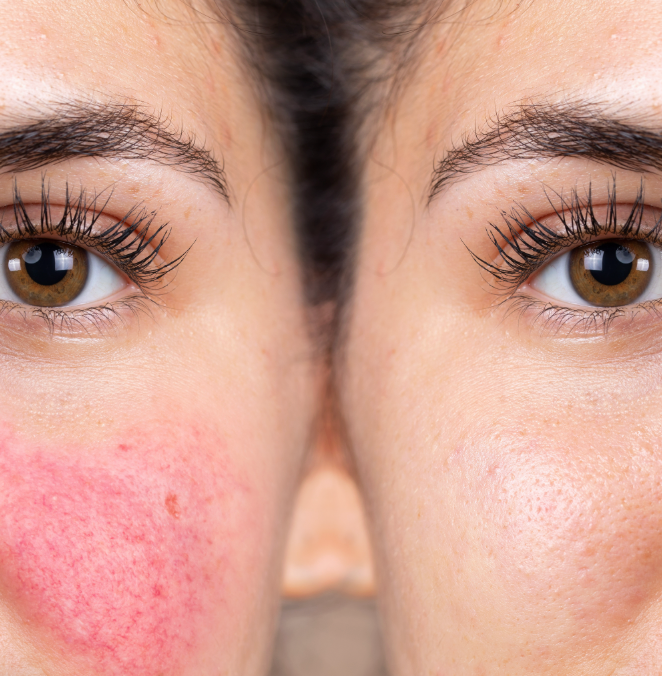
A skin barrier under pressure can show itself in different ways. People often call this a 'damaged' or 'broken' skin barrier. We prefer to speak of a disrupted barrier, because in most cases the skin recovers once you give it the space to do so.
Possible signs that your skin barrier is disrupted:
- a dry or tight feeling;
- flaking or a rougher skin texture;
- redness that appears more quickly;
- more sensitivity than usual;
- products that suddenly sting or burn;
- skin that stays uncomfortable despite hydrating products.
Oily or blemish-prone skin can also have a disrupted barrier function. Oil production and the way the skin barrier works are two different things. Skin can therefore look shiny and still be dehydrated or sensitive.
Cleansing or degreasing more and more is not automatically the answer in that situation. When the skin is already vulnerable, it can actually add extra stress.
Does your skin barrier feel damaged? These signs are not a diagnosis. If you have persistent redness, itching, pain, inflammation or other clear skin complaints, it is wise to see your GP or a dermatologist.
What can throw the skin barrier off balance?
There is usually no single cause. Skin can become more sensitive when different kinds of stress build up. Think of:
- cleansing too often or too intensively;
- frequent scrubbing or exfoliating;
- combining several strong active ingredients;
- very hot water;
- cold, wind or dry air;
- a lot of UV exposure without enough protection;
- skincare that doesn't suit the current condition of your skin.
An extensive skincare routine can quietly do a lot at once. Retinoids, exfoliating acids and other active ingredients have their place in skin improvement, but your skin has to be able to tolerate them.
A product that normally works well can be temporarily too intense when the skin is already dry, sensitive or reactive. That is why at Glam Skin we look at the whole routine: what you use, how often, in which combination and how your skin responds.
Want to repair your skin barrier? Start by disrupting it less
When your skin suddenly turns dry or sensitive, it is tempting to buy an extra serum, mask or cream. It often makes more sense to look at the routine itself first: which steps are needed, and what can be scaled back for now?
If you want to repair your skin barrier, this order is a good guide:
1. cleanse gently → 2. give moisture and lipids → 3. protect during the day → 4. then build back up slowly
Especially for skin that reacts easily, simplicity brings clarity. You can see much better what your skin does and doesn't tolerate.
What is best to cut back on for now?
Is your skin stinging, flaking or clearly more sensitive than before? Then look first at the most intensive parts of your routine. Depending on what you use, it may be wise to temporarily use these less often or not at all:
- exfoliating acids;
- physical scrubs;
- strong peels;
- several active serums at the same time;
- retinoids at a high frequency when your skin is reacting badly to them.
That says nothing negative about these ingredients. They can be very useful for improving the skin. The timing, frequency and condition of your skin simply determine how much it can handle.
Step 1 — cleanse gently
Cleansing removes make-up, sunscreen, sebum and dirt from the surface of the skin. Your skin doesn't need to feel tight or completely oil-free afterwards.
Some cleansing agents can remove lipids from the outer layer of the skin. When the barrier is already vulnerable, intensive cleansing can therefore lead to more tightness or sensitivity. Choose a gentle cleanser that suits your skin's condition, use lukewarm water and avoid rubbing hard.
For sensitive skin, Dr. Schrammek Sensiderm Cleansing Solution is a good example. It is a gentle, fragrance-free micellar cleanser developed for sensitive skin.
Want to read more about how cleansing affects your skin? Why a gentle cleanse is essential for your skin
Step 2 — give your skin moisture and lipids
Hydration and barrier support are often lumped together. Yet they don't do exactly the same job.
Hydrating ingredients help attract or hold on to water. Barrier lipids are part of the structure between the skin cells. A product can therefore hydrate the skin well without automatically doing the same job as skincare that also replenishes lipids.
Ingredients for hydration
Glycerin and hyaluronic acid are widely used for their hydrating properties. For dehydrated skin, they can help support moisture levels and comfort.
Ingredients that match the lipid structure
Ceramides, cholesterol and fatty acids occur naturally in the lipids of the skin barrier. In skincare you will also see related substances, such as plant sterols and ceramide-like compounds.
Ceramides get a lot of attention, but the mere fact that a cream contains ceramides doesn't tell you enough. The formulation, the ratios and the other ingredients matter too.
Ingredients for comfort
Squalane, panthenol and centella asiatica are often used in skincare for dry or sensitive skin. Squalane helps the skin feel supple and soft. Panthenol and centella are common in soothing, nourishing formulas.
Niacinamide
Niacinamide, also known as vitamin B3, can support processes involved in producing certain skin lipids. That makes it a useful ingredient in some barrier routines. Not every skin responds to niacinamide in the same way; the concentration and the rest of the formula influence how well a product is tolerated.
Which skin barrier cream is right for you?
There is no single skin barrier cream that is the best choice for every skin. Things to consider include:
- whether your skin is naturally drier or oilier;
- how much nourishment and comfort your skin needs;
- which active products you use alongside it;
- sensitivities to certain ingredients, such as fragrance;
- the season and your environment;
- a texture you enjoy enough to use every day.
Looking for a barrier repair cream for dry, sensitive or easily reddened skin? Then Dermalogica Stabilizing Repair Cream is a good option.
The cream has a balm-like texture and is fragrance-free. The formula combines squalane, shea butter and jojoba oil with fatty acids, plant sterols and a ceramide-like compound. Dermalogica calls this combination its 'Ceramide-Building Complex'. It also contains soothing ingredients such as centella asiatica and a liquorice root derivative.
This shows exactly why the label alone doesn't tell the whole story: classic ceramides aren't at the top of the ingredient list, but the formula works with the same building blocks your skin uses itself. Want to test how your skin reacts first? The cream is also available as a 15 ml travel size.
A barrier repair cream works best within a simple routine. The complete formula and how your skin responds matter more than the best-known ingredient on the packaging.
Serum, fluid or spray: do you need one?
Not necessarily. When a good cream provides enough hydration, lipids and comfort, there is no need to add another step. Always see an extra product as a supplement, not an obligation.
A soothing fluid
Does your skin feel tight, warm or red, or are you looking for a lighter layer under your cream? Then a soothing fluid can be useful. Dr. Schrammek Soothing SOS Fluid is a light, fragrance-free fluid in an airless pump. The formula includes aloe vera, squalane, shea butter, hyaluronic acid, centella asiatica and liquorice root extract.
For oilier skin with a disrupted barrier, a fluid like this can sometimes be enough on its own as light care. For dry skin, use it underneath your cream.
A skin barrier spray
A skin barrier spray is especially handy for giving your skin extra moisture after cleansing or throughout the day. Dermalogica Hyaluronic Ceramide Mist contains ceramide NP, several forms of hyaluronic acid and panthenol. The formula also contains rose water; if your skin reacts to scented ingredients, test it on a small area first.
A spray doesn't replace your cream. It mainly adds moisture, while the cream provides lipids and comfort.
Step 3 — protect your skin from UV during the day
UV radiation is one of the factors that can put extra stress on the skin. If you want to repair your skin barrier, you can't skip sun protection, not even on cloudy days or in winter.
Finish your morning routine with a broad-spectrum sunscreen that your skin tolerates well. For sensitive skin, the fragrance-free Dr. Schrammek Sensiderm Sun Cream SPF 50+ is a good example.
Want to read more? Sun protection: an essential step in skincare
Step 4 — reintroduce active ingredients slowly
There is no fixed recovery time for a disrupted skin barrier. How quickly your skin becomes more stable depends on the cause, its condition, the products used, any further stress and possible underlying skin issues.
So pay attention mainly to what your skin is telling you. Does it feel more comfortable again, is it less sensitive, and does it tolerate your basic routine without problems? Then you can slowly reintroduce active skincare:
- start with one active product;
- use it less often than before at first;
- don't change several other steps at the same time;
- watch how your skin responds for a few days;
- only increase the frequency if your skin stays calm.
Does your skin become tight, flaky or clearly more sensitive again? Then look again at the frequency, the combination and the amount of active skincare. Improving your skin isn't about using as many actives as possible at once, but about an intensity that matches what your skin can tolerate at that moment.
Routine: how to repair your skin barrier on your face
A simple routine to repair your skin barrier on your face doesn't have to be long. Here is an example you can adapt to your own skin.
Morning
- Cleanse if needed. Not every skin needs the same cleansing in the morning. Use a gentle formula or just lukewarm water.
- Optional fluid or spray. Only when it has a clear purpose, such as extra moisture or calm for reddened skin.
- Cream. Choose skincare that provides enough moisture, lipids and comfort.
- SPF. Finish with broad-spectrum sun protection.
Evening
- Cleanse gently. Remove make-up, sunscreen and dirt without stripping the skin unnecessarily.
- Optional fluid. Only use an extra product when it adds something.
- Skin barrier cream. Finish with skincare that suits the condition of your skin; in the evening it can be a little richer.
More steps don't automatically make a routine better. A routine your skin tolerates well and that you use consistently gives you far more insight into what does and doesn't work. Why a consistent skincare routine is important
Strengthening your skin barrier in the long term
Recovery is one thing; strengthening your skin barrier and keeping it strong is a matter of habits. For dry skin, an extra hydrating product seems the obvious choice, but that isn't always the full story. If the skin is also being cleansed intensively, exfoliated often or getting too few lipids, an extra hydrating step does little to change those other sources of stress.
If you want to strengthen your skin barrier, ask yourself these questions regularly:
- How do I cleanse, and how does my skin feel afterwards?
- Which active ingredients do I use, and how often?
- Does my cream give enough moisture and lipids?
- Do I protect my skin from UV every day?
This makes it clearer where your skin really needs support. Hydration and protection: the role of creams in your routine
When is personal skin advice worthwhile?
If you can't work out why your skin is suddenly reacting differently, it can help to look at your whole routine together. At Glam Skin we look at your skin condition, current skincare, the active ingredients you use and the result you want to achieve.
Sometimes an extra product is needed. In other cases, we actually take something out of the routine for a while. After that, skin improvement can be built up again step by step, starting from skin that has had enough rest and support.
For severe, persistent or unexplained skin complaints, cosmetic advice is not enough. In that case, please consult your GP or a dermatologist.
Stabilise first, then keep improving
Repairing your skin barrier doesn't call for as many products as possible. Start with the question what your skin needs right now and which stress you can reduce.
Gentle cleansing, enough moisture and lipids, daily protection and a routine your skin tolerates well form a strong foundation. Once your skin feels comfortable and stable again, you can gradually reintroduce active skin improvement.


